greyridge-x402-tools
The MCP exposure census: ~half of public MCP servers expose their full tool list with no authentication
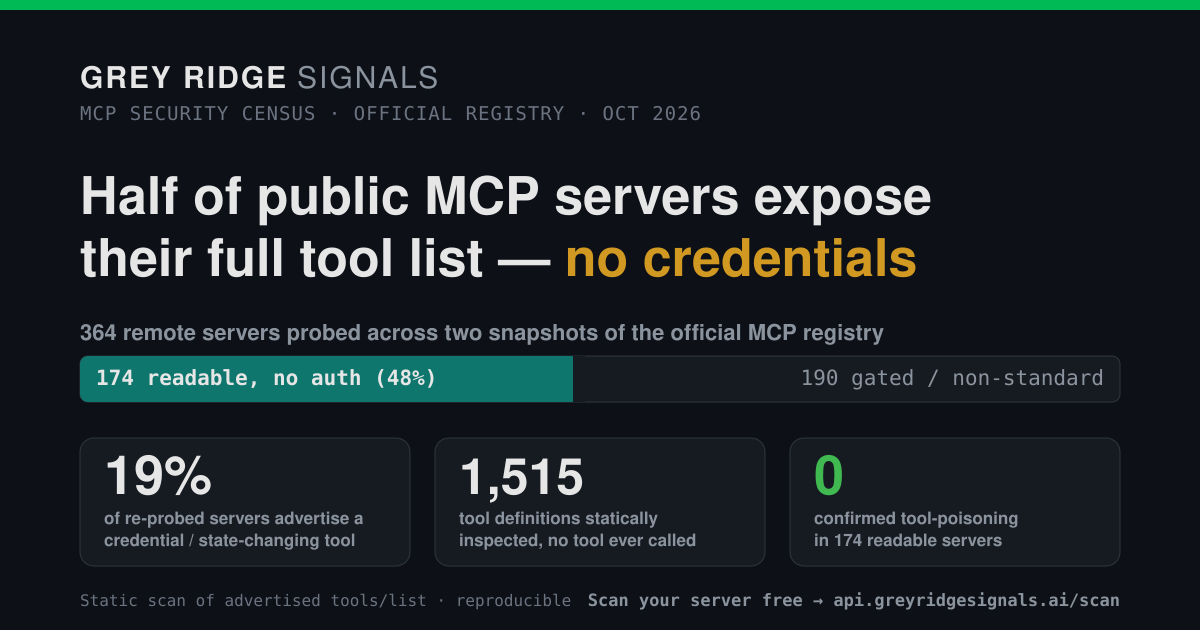
Key finding. Across two snapshots of the official MCP registry (registry.modelcontextprotocol.io), 174 of 364 remote servers probed — 48%, and between 44% and 55% in any single pass — answered a tools/list request with no credentials at all, handing their complete tool surface (every tool name, description and JSON schema) to any anonymous client. That metadata is exactly what an LLM reads before it calls anything, so it is also the prompt-injection / tool-poisoning attack surface — and it is attacker-mutable on every server update.
The second finding is the one most coverage gets wrong: confirmed tool-poisoning in that readable population is 0% (0 of 174). The public MCP ecosystem is wide open to inspection but is not, today, riddled with overt poisoning. Both facts matter, and they point at the same product.
Method: each streamable-http remote in the registry was sent to the free GET /scan/mcp/preview?url= endpoint of the Grey Ridge scanner — static analysis of the advertised tools/list metadata (descriptions, schemas, hidden unicode) only; no tool is ever invoked. Snapshot 1 raw rows: benchmarks/registry_census/raw.jsonl; reproduce with scripts/registry_census.sh. Figures are measured, not modelled (Claims Law).
| snapshot | remotes probed | readable with no credentials | share | tools scanned | clean verdict | confirmed poisoning |
|---|---|---|---|---|---|---|
| 2026-10-20 | 246 | 109 | 44% | 987 | 109 / 109 | 0 |
| 2026-10-22 | 118 | 65 | 55% | 528 | 65 / 65 | 0 |
| pooled | 364 | 174 | 48% | 1,515 | 174 / 174 | 0 (0.00%) |
The servers that did not answer were credential-gated, SSE-only, or returned 403/530/timeout — roughly the other half. “Readable with no credentials” is not itself a verdict of insecure: many MCP servers are intentionally public (read-only data, open tools). The point is narrower and firmer — for about half the registry, the full tool surface an agent will trust is inspectable by anyone, and nothing about that surface is fixed between updates.
What the two numbers mean together
A point-in-time scan of a registry server almost always returns CLEAR — the real-world poisoning hit rate is ~0. So one-shot scanning has no acute “here is your problem” moment to sell. The durable, payable value is not catching a poisoned server (a rare event) but continuous assurance: every tool description is attacker-mutable the next time a server ships, so clean today is not clean forever. The case is scanning on every connect and alerting on drift — a recurring attestation, not a one-time catch. That is why the product is the monitoring plan, not the free one-shot scan.
Scanner accuracy (honest bounds)
The one block in the first snapshot was a scanner false positive — the rule never tell ... the user matched a benign accuracy instruction (“Never tell the user a likely_available name is available”). Reproduced locally, the rule was narrowed to concealment phrasing, and the sample plus two true-poisoning variants were added to the corpus (now n=45: local analyzer recall 1.00 / precision 1.00, in-sample — not a guarantee on unseen servers). Corrected reading: 174/174 readable remotes clear across both snapshots.
What’s behind the open tool surface — a second cut
A follow-up pass re-queried tools/list on every server from the first snapshot that had answered unauthenticated, to look past the count of readable servers and at what they expose. Of the 109, 93 re-answered on 2026-10-22 (the other 16 had since churned, gone credential-gated, or returned errors), advertising 833 tools in total.
The readable registry skews benign-public. About four in five of the re-probed servers (75 of 93) advertise only read-only lookup tools — search, get_*, list_*, directory and catalogue endpoints. That is the expected shape of a public registry and it is consistent with the 0% poisoning rate: most servers that answer anonymously are meant to.
But a real minority expose a sensitive tool surface to anonymous callers. A high-precision pass for state-changing or credential-scoped tools flagged a handful of servers whose advertised surface — the names, descriptions and JSON schemas any anonymous client can read before trusting them — includes operations like these (verified live, quoting each server’s own tool descriptions):
- A secrets manager advertises
request_secret,get_secret_link(“answer where is my Acme password? with somewhere to go”) andadd_connection(sign-in links for third-party sites). - An API-key console advertises
create_api_key(issues…_live_…keys with scopes),revoke_api_keyandconnect_sportsbookaccount-linking. - An open-banking server advertises
open_banking_transactions(“bank account balances and transaction history via PSD2 Open Banking, 300+ UK and European banks”),bank_accountsandstripe_payment_records. - A social/identity server advertises
delete_account(“permanently delete the identity belonging to this credential”).
A crucial, honest boundary: a readable tools/list means the surface is anonymous — anyone can enumerate that a server offers banking, secret-vault, key-issuance or account-deletion capabilities and read the exact schema an LLM will act on. It does not prove those actions execute without a credential (most are scoped to “this account”). The exposure is recon and prompt-injection surface, not proof of unauthenticated execution. That is still the live risk: the surface is attacker-visible and attacker-mutable on every deploy.
This is what sharpens the product. The 81% read-only majority rarely needs more than a point-in-time CLEAR. The servers that matter are this sensitive minority — where an open, drifting tool surface describing money movement, credentials or destructive actions is exactly the thing worth watching on every connect. Method and the per-server matches are reproducible from scripts/census_capability_cut.py.
Check your own MCP server (free, no account)
curl -s "https://x402-data-api.sigrunner.workers.dev/scan/mcp/preview?url=https://YOUR-HOST/mcp"
# behind auth or stdio-only — POST your own tools/list, nothing leaves your machine:
curl -s -X POST https://x402-data-api.sigrunner.workers.dev/scan/mcp/preview \
  -H 'content-type: application/json' -d '{"tools":[...]}'
Itemized findings with evidence and OWASP LLM01/LLM08 mapping: paid /scan/mcp ($0.05, x402 on Base). Continuous drift monitoring with alert-on-change: $9.99/mo. Contact: contact@greyridgesignals.ai